Nine specialized agents and a custom skill, orchestrated by Claude Code Agent Teams, performing comprehensive security assessments entirely autonomously.
Claude Code Agent Teams lets you orchestrate multiple Claude Code sessions working together. One session acts as the team lead, coordinating work and spawning teammates — each a full Claude Code instance with its own context window, running in parallel.
I built nine specialized agents and a custom threat modeling skill on top of this. The team lead orchestrates an eight-phase assessment pipeline — spawning the right specialist for each phase, coordinating via shared task lists and inter-agent messaging, and consolidating everything into a multi-format report.
The entire output — architecture diagrams, 26 findings with OWASP risk scores, compliance mappings across four frameworks, privacy analysis, and a remediation roadmap — is produced without a single human edit.
Unlike sub-agents that only report back to a parent, Agent Teams teammates message each other directly, share discoveries mid-task, claim work from a shared task list, and coordinate without a human intermediary. Each teammate loads project context and the custom skill but operates in its own context window.
Three views of the orchestration system — from high-level architecture to the step-by-step execution pipeline and full component map.
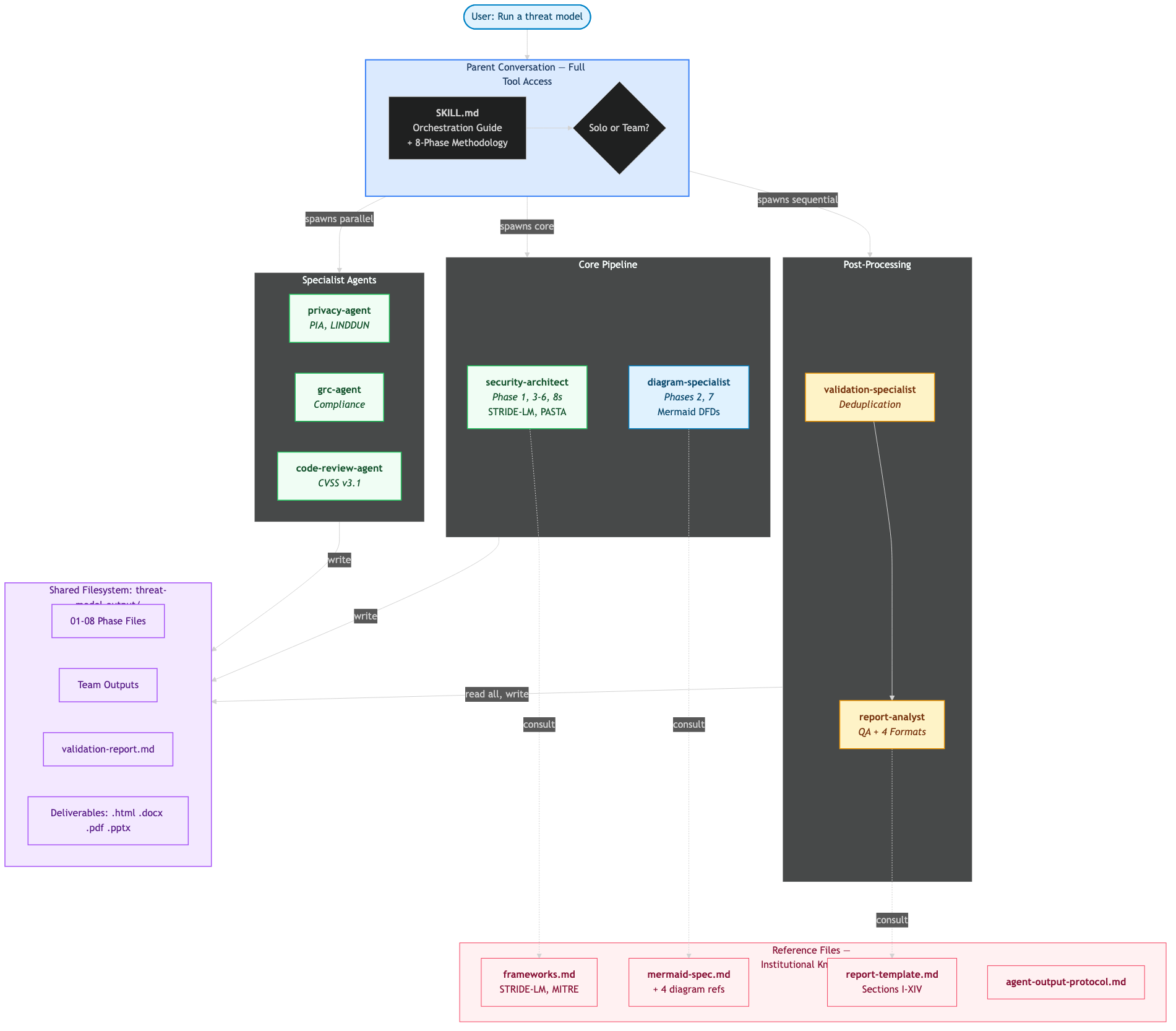
Parent orchestrator spawns core agents (sequential), specialist agents (parallel), and post-processing (sequential). All share a filesystem and consult institutional reference docs.
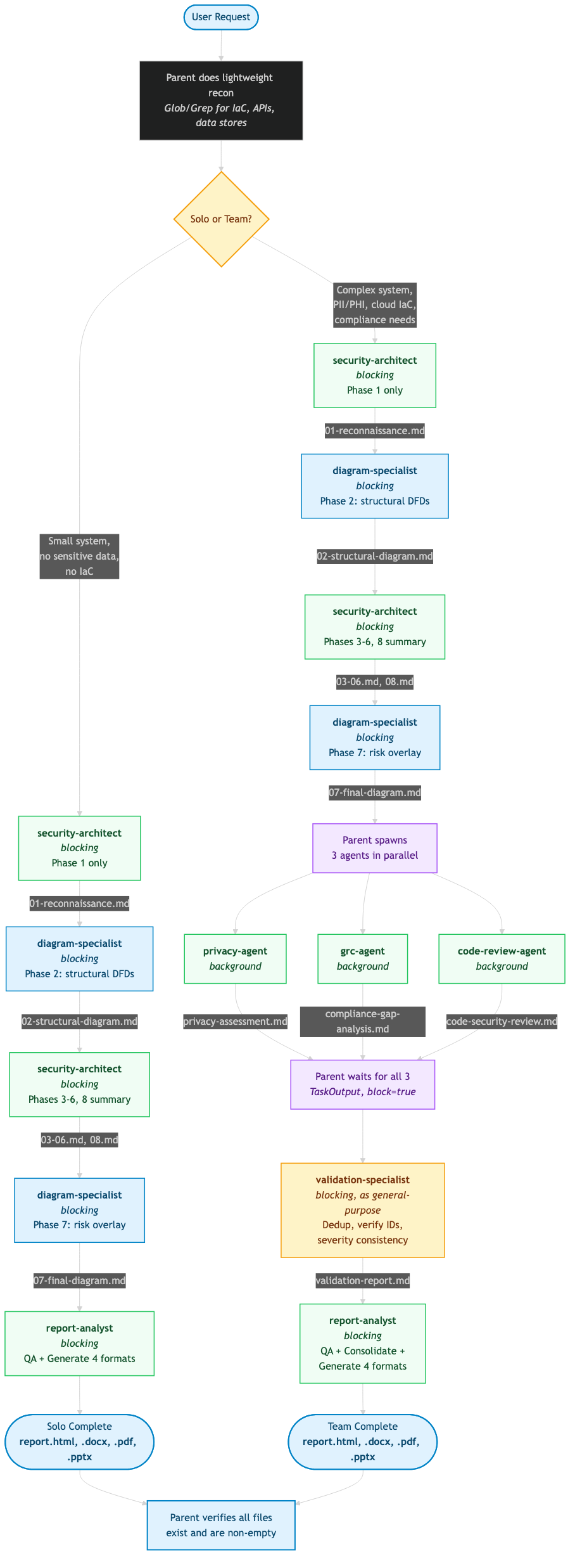
Solo path for simple systems, Team path for complex ones. Team mode forks 3 specialists in parallel, joins results, validates, then generates 4 report formats.
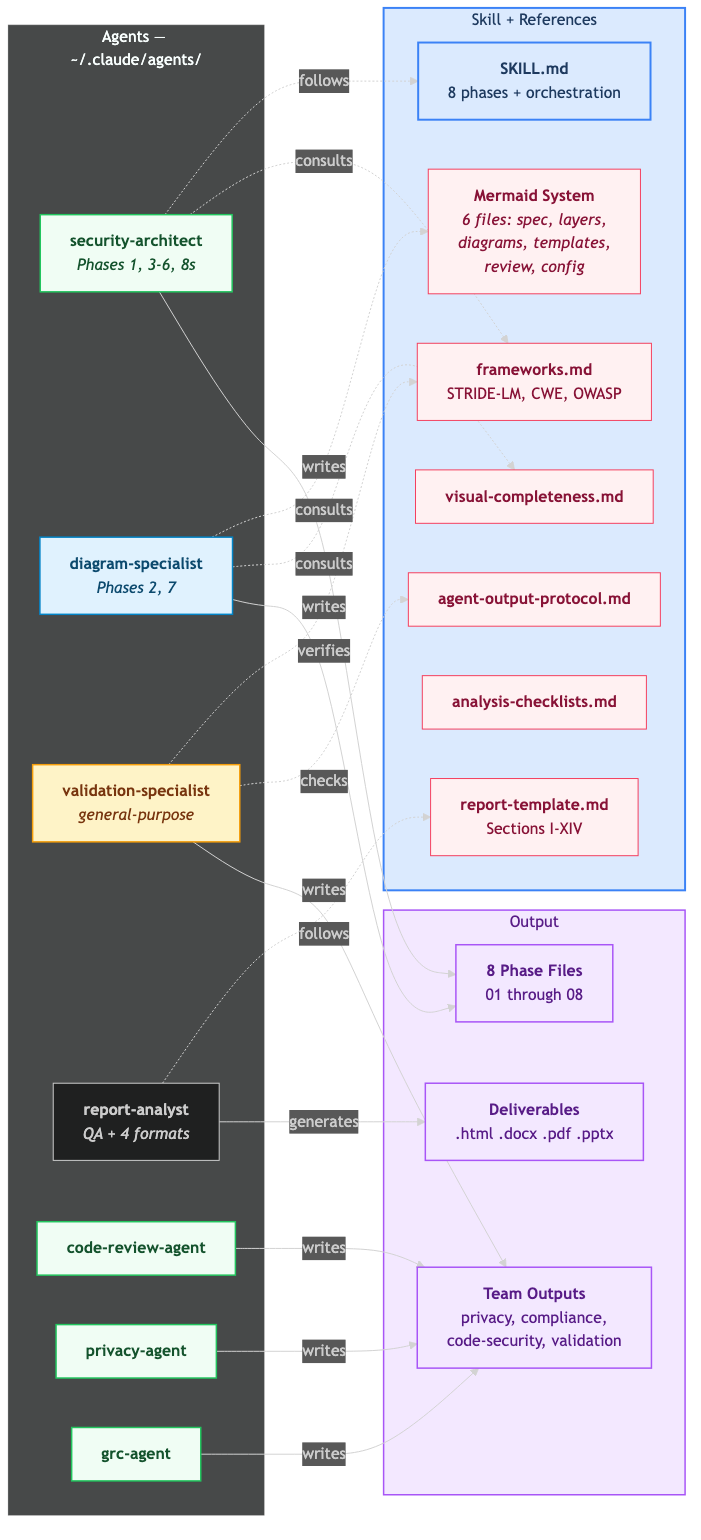
The full component inventory: 1 custom skill, 11 reference files (including 6-file Mermaid diagram system), 7 agent definitions, and structured output directory.
The team lead orchestrates each phase, spawning the right specialist. Every agent runs Claude Opus 4.6 with Extended Thinking.
The custom skill encodes industry-standard frameworks into every agent's workflow — automated risk scoring and compliance mapping baked in.
Spoofing, Tampering, Repudiation, Info Disclosure, DoS, Elevation of Privilege — plus Lateral Movement.
Process for Attack Simulation and Threat Analysis — risk-centric, attacker-focused methodology.
Likelihood × Impact (1–5) producing 1–25 risk scores mapped to severity bands.
Linkability, Identifiability, Non-repudiation, Detectability, Disclosure, Unawareness, Non-compliance.
Assessment of an AWS ECS Fargate demo application deployed via Terraform. Severity distribution reveals significant security gaps across infrastructure, CI/CD, and application layers.
| ID | Severity | Title | Score |
|---|---|---|---|
| TM-004 | Critical | Repository-Sourced Buildspec + Broad IAM | 25 |
| TM-003 | Critical | IAM PassRole Wildcard (*) | 20 |
| TM-023 | High | No Branch Protection | 16 |
| TM-013 | High | CodeBuild Privileged Docker | 16 |
| TM-014 | High | No Pipeline Approval / Scanning | 16 |
| TM-001 | High | No TLS/HTTPS on ALBs | 15 |
| TM-002 | High | No Authentication/Authorization | 15 |
| TM-005 | High | GitHub Token in TF State | 15 |
| TM-006 | High | Mutable ECR Tags + Latest | 15 |
| TM-007 | High | No WAF or Rate Limiting | 12 |
| TM-022 | High | Unrestricted ECS Egress | 12 |
| TM-024 | High | No Billing Alarm | 12 |
| TM-009 | Medium | S3 Missing Security Controls | 9 |
| TM-011 | Medium | No VPC Flow Logs | 9 |
| TM-015 | Medium | Outdated Dependencies | 9 |
| TM-017 | Medium | Container Hardening Deficiencies | 9 |
| TM-012 | Medium | Error Handler Info Leakage | 8 |
| TM-025 | Medium | npm install vs npm ci | 8 |
| TM-008 | Medium | Unrestricted CORS | 6 |
| TM-018 | Medium | Single NAT GW (SPOF) | 6 |
| TM-021 | Medium | No Container Insights | 6 |
| TM-026 | Medium | No CloudTrail Data Events | 6 |
| TM-016 | Medium | Swagger Publicly Exposed | 5 |
| TM-010 | Low | DynamoDB No PITR/CMK | 4 |
| TM-019 | Low | No VPC Endpoints | 4 |
| TM-020 | Low | SNS No Subscribers/Encryption | 3 |
Each finding is automatically mapped to relevant controls across four major compliance frameworks, generating coverage metrics.
Demo target: an AWS ECS Fargate reference architecture deployed via Terraform. Four deliverables, zero human edits.